Home / PSLE Math Tuition
Primary 5 and 6 · PSLE Standard Math · Katong and Hougang
P5 and P6 PSLE Math Tuition in Singapore
Small P5 and P6 Math classes at our Katong and Hougang centres, 2 hours once a week, for students taking Standard Math at the PSLE. P5 brings percentage, rate and fractions in full; P6 adds ratio, average, algebra and circles, then turns into revision. We teach each topic in MOE's order, worked out on the screen, and train the heuristics so your child knows which one to use, not just what they are called.
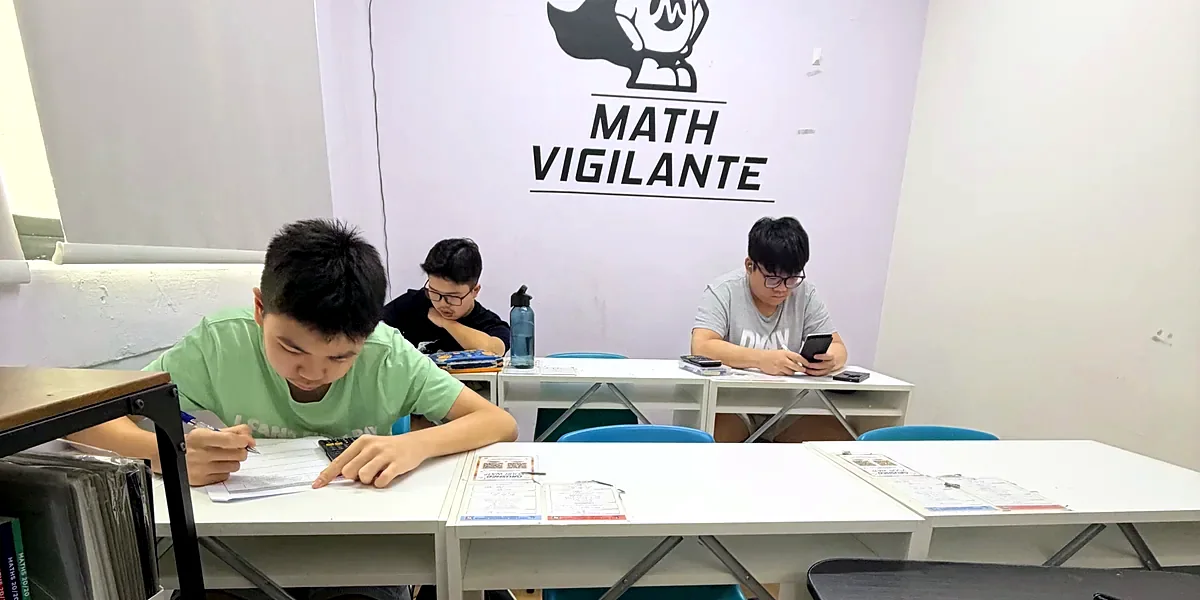
- 2 h
- once a week, in a small class
- 100
- marks over two PSLE papers; Paper 1 has no calculator
- 2 areas
- Katong and Hougang both run P5 and P6 classes
Who this class is for
- P5 students meeting percentage and rate for the first time, and finding that the model drawings from P4 no longer fit every question.
- P6 students in the PSLE year who know the heuristics by name but not when to use which, and lose Paper 2 time on one hard question.
- Students whose P5 end-of-year result was lower than expected. P5 is where the question types multiply, and the marks lost there are usually one or two topics, not a weak child.
- Students already scoring well who want AL1. At that level the marks sit in the last questions of Paper 2 and in careless slips on Paper 1, and both can be trained.
What P5 and P6 Math covers
The PSLE tests the whole of MOE's 2021 Primary Mathematics syllabus, but most of the marks come from the P5 and P6 topics below. P5 is the heavier year: whole numbers to 10 million, fractions and decimals in full, then percentage and rate. P6 adds ratio, average, algebra and circles (speed is no longer in the primary syllabus; it moved to Sec 1 in MOE's 2021 revision), and spends the second half of the year on revision and the heuristics. Our classes follow this order.
- P5: Whole numbers to 10 million, and the order of operations
- P5: Fractions: multiplying and dividing
- P5: Decimals: the four operations, and converting between decimals and fractions
- P5: Percentage
- P5: Rate
- P5: Area of a triangle
- P5: Volume of cubes and cuboids
- P5: Angles on a straight line, at a point, and vertically opposite
- P5: Triangles and four-sided figures: their properties, finding unknown angles
- P6: Fractions: dividing by a fraction
- P6: Ratio: all of it, including changing ratios
- P6: Percentage: part of a whole, increase and decrease
- P6: Algebra: simple linear expressions
- P6: Circles: area and circumference
- P6: Volume: cubes, cuboids, and finding a side from the volume
- P6: Angles in composite figures
- P6: Average
- P6: PSLE revision and the heuristics
| PSLE Math paper | Time and marks | What is in it |
|---|---|---|
| Paper 1 | 1 hour 10 minutes · 50 marks · no calculator | Booklet A: 18 multiple-choice questions. Booklet B: 12 short-answer questions. Covers the whole syllabus quickly; careless slips cost the most here. |
| Paper 2 | 1 hour 20 minutes · 50 marks · calculator allowed | 5 short-answer questions, then 10 longer structured questions worth 3 to 5 marks each. This is where the heuristics and the time management are tested. |
Format from SEAB's PSLE Mathematics (Standard) syllabus for examination from 2026: 100 marks, half in each paper over two papers, graded in Achievement Levels from AL1 (90 marks and above) to AL8 (below 20). The 2027 PSLE written papers are expected in late September to early October 2027; MOE's dates are tentative until MOE confirms them.
Standard Math only
Our P5 and P6 classes teach the Standard Math syllabus; we do not run Foundation Math classes. If your child's school has placed them in the other stream, WhatsApp us and we will tell you honestly whether our class is the right fit.
Where P5 and P6 students usually get stuck
Every topic above has a typical way of going wrong. These are the ones we see most in class, and what we do about each. If one sounds like your child, tap the button under it and tell us; we will say which class fits.
P6
Ratio and fractions in one question
Where it goes wrong: Ratio and fractions get mixed up in one question: 2 : 3 becomes 2/3, or a fraction 'of the remainder' is taken from the whole.
What we do: Units and parts first. Every ratio and fraction question is drawn as units before any arithmetic, so the child sees what the 2 and the 3 are parts of.
WhatsApp us about this topicP5
Percentage
Where it goes wrong: Finds 20% of the wrong number, usually the new amount instead of the original, in discount and GST questions.
What we do: One question before every working: '100% is what?' Written down first, every time, until the child does it without being told.
WhatsApp us about this topicP5
Rate
Where it goes wrong: Rate looks like a new topic but is division in disguise. The child divides the wrong way round and gets a rate that cannot be right.
What we do: Units written at each step ($ per hour, litres per minute), so a wrong division gives a wrong unit the child can spot.
WhatsApp us about this topicP5
Multiplying and dividing fractions
Where it goes wrong: Dividing by a fraction gives a bigger answer, the child does not expect it, so the right answer looks wrong and gets changed.
What we do: Estimate first, picture second, rule last. Dividing by a half is 'how many halves' before 'flip and multiply' is ever mentioned.
WhatsApp us about this topicP5
Angles and figure properties
Where it goes wrong: Knows the angle facts but cannot find them in the figure: a straight line is missed because it is drawn at a slant, or an isosceles triangle is not recognised.
What we do: We mark every figure before calculating: equal sides, parallel marks, right angles, the straight lines. The facts are found before they are used.
WhatsApp us about this topicP6
Average
Where it goes wrong: Finds the total and divides by the wrong number of items, or cannot work backwards: given the average and all but one value, the child does not see that total comes first.
What we do: One rule drawn every time: total = average × number of items. The child writes the total first, then whatever is missing falls out of it.
WhatsApp us about this topicP6
Algebra
Where it goes wrong: Treats 3x as 3 + x, or cannot turn a word problem into an expression. Simplifying with fractions is where most of the marks go.
What we do: Algebra taught as model drawing with letters: the unit is x. Then simplifying in small steps, one rule at a time.
WhatsApp us about this topicP6
Circles and composite figures
Where it goes wrong: Cannot tell which part of a composite figure is a quarter circle and which is a semicircle, and adds the straight edges into the length of an arc.
What we do: Shade and name every piece first, then write the formula for each piece separately before adding.
WhatsApp us about this topicP6
Heuristics: known by name, not by use
Where it goes wrong: Can recite model drawing, guess-and-check, before-after and working backwards, but cannot tell from a question which one to reach for.
What we do: We teach the signals: what a before-after question sounds like, what a gaps-and-intervals question looks like. Then mixed practice, so the choice is trained, not just the recipe.
WhatsApp us about this topicP6
Paper 2 time
Where it goes wrong: Spends ten minutes on one hard question, runs out of time, and leaves easier marks at the end of the paper blank.
What we do: Near the exams, revision sets built from past papers with one simple rule: mark it, skip it, come back. The occasional short timed quiz shows where the time goes.
WhatsApp us about this topicThese are the common patterns, not a list of what your child does. The trial lesson and the Post Trial Analysis & Feedback tell you which ones apply.
How we teach PSLE Math
P5 and P6 classes are 2 hours, in a small group, so the tutor sees how your child works through a question, not just the answer. New topics are taught in MOE's order; in P6 the class turns to revision by question type, with sets built from past papers.
Every lesson runs in the same order, whatever the topic. Tap a step to see what it looks like in our own notes and worksheets.
A lesson, in order
The full method, including what happens at the trial and after each school test, is on The Vigilante Method.
This is what a lesson looks like
Also included
- Small classes of 2 hours, once a week, at Katong or Hougang.
- Our own notes and worksheets, following the MOE primary syllabus, plus revision sets by heuristic and by question type for the PSLE year.
- Help outside class: usually a class WhatsApp group with the tutor, for updates, worksheet solutions and quick questions.
- A message from the tutor after each school test, with what improved and what the class is working on next.
- We follow MOE's order of topics. When a school teaches in a different order, tell the tutor and the class covers it before the test.
After the PSLE: Sec 1 Math
The PSLE score sets the Posting Group, and Math can start higher than the other subjects: a student posted to G2 with Standard Math AL5 or better can take Math at G3 from the start of Sec 1. Sec 1 replaces model drawing with algebra, and the students who settle fastest are the ones whose P6 algebra and ratio were solid.
Our 2027 Sec 1 classes start on Saturday 31 October 2026, after the PSLE. G2 and G3 students learn together, so nothing changes when the posting letter comes.
What we see in class
In our experience, the P6 students who settle fastest in Sec 1 are the ones who can write working a stranger can follow, whatever their AL. A secondary marker gives marks for the method, not just the answer, so we start that habit in P5.
- PSLE score calculator: AL score, Posting Group and which Sec 1 subjects can start at G3
- Sec 1 Math tuition: 2027 classes start 31 October 2026
A result from one of our P6 students
A P5 to P6 story from one of our students, in the parent's own words and on the paper itself. Tap an image to see it in full.
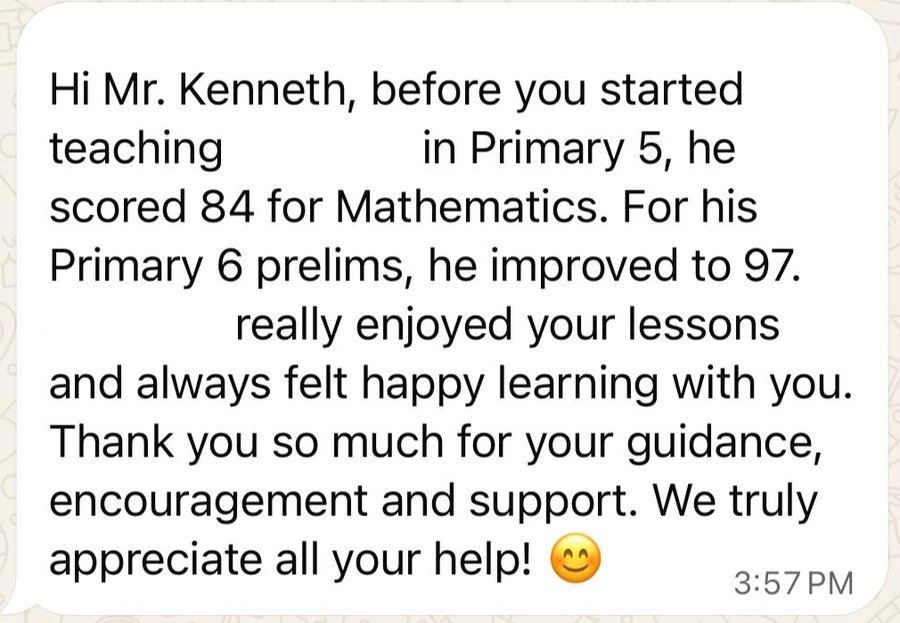
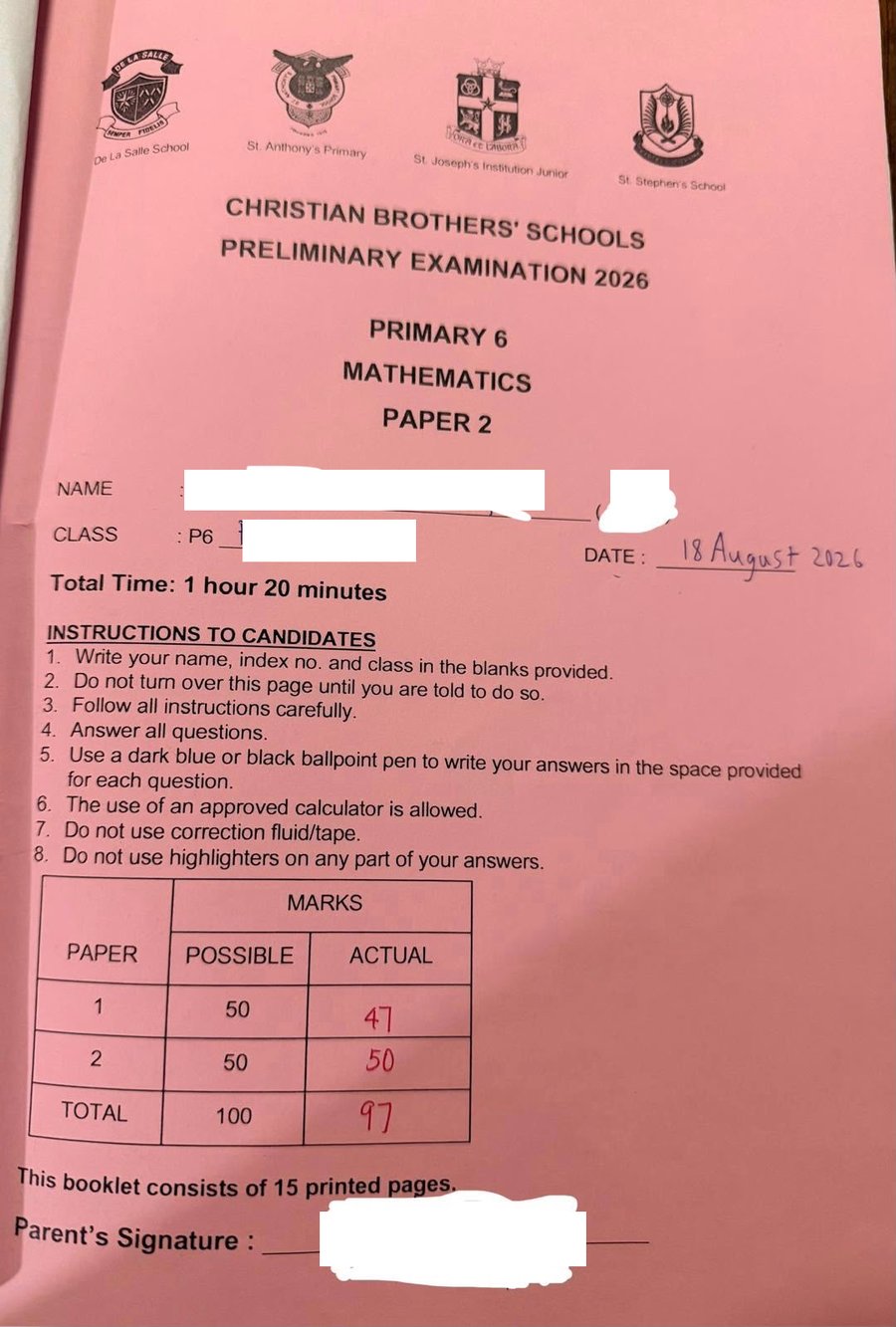
Real results shared by our students and parents, with names removed. More on our results page.
Fees
Per 4 lessons of 2 hours each, once a week. The same rate for P5 and P6, at Katong and Hougang.
| Level | Fee | Lessons |
|---|---|---|
| P5 and P6, families enrolled by 31 Dec 2026 | $260 | 4 lessons of 2 h ($65 each) |
| P5 and P6, new families from 1 Jan 2027 | $280 | 4 lessons of 2 h ($70 each) |
- Families enrolled by 31 December 2026 stay on the 2026 price list for the whole of 2027; fees still follow your child's level.
- Registration fee $50, waived when your child starts by 30 November 2026 or is referred by a current Math Vigilante family.
- No deposit for families who enrol before 1 January 2027. New families from 1 January 2027 prepay four lessons, which pay for the final month when you give notice.
- Billed monthly for the lessons in that calendar month, usually 4, sometimes 5.
- Trials are paid lessons, by appointment. Your child sits in on a real class, and you receive a written Post Trial Analysis & Feedback on where the marks are being lost.
- Financial assistance (FAS) is available case by case: show us proof, and we will see what we can do, subject to availability. WhatsApp us for more info.
- No GST.
Where the classes are
P5 and P6 classes run at Katong and at Hougang. Timetables change each term, so we do not list days and times here: WhatsApp us to check the current slots, and tell us your child's school so we can place them in a class at the same point in the syllabus.
Hours: Monday to Friday 2:30pm to 9:30pm · Saturday and Sunday 9:00am to 6:00pm. WhatsApp 8042 6428 for the current P5 and P6 PSLE Math timetable at each centre, or see the class schedule.
The PSLE heuristics, and how we teach when to use each
Heuristics are the problem-solving methods the PSLE expects: model drawing, units and parts, before-and-after, guess-and-check (supposition), working backwards, gaps and intervals, and spotting a pattern. Schools teach them one at a time; the PSLE mixes them up and gives no hint which one to use.
That gap is what we train. Each heuristic has signals in the wording: 'at first … in the end' points to before-and-after; 'how many of each, if there are 20 legs altogether' points to supposition; lamp posts along a road point to gaps and intervals. Students learn the signal together with the method, then practise them mixed, the way a real paper asks them.
- PSLE score calculator: AL score, Posting Group and Sec 1 subject levels
- The Vigilante Method: how every lesson runs
Frequently asked questions
Which tutor teaches the P5 and P6 class?
It depends on the centre and the slot. Several of our tutors teach primary, and the class your child joins is set by the timetable and by the other students' level, not by a fixed name. Every tutor teaches from the same notes in the same lesson order, and your child's tutor messages you after each school test.
What does the PSLE Math paper look like?
Two papers, 50 marks each. Paper 1 (1 hour 10 minutes) has no calculator: Booklet A is multiple choice and Booklet B is short answer. Paper 2 (1 hour 20 minutes) allows a calculator and is mostly longer structured questions. This is the format SEAB set from the 2026 PSLE. Grades are Achievement Levels: AL1 is 90 marks and above, AL8 is below 20.
Do you teach Foundation Math?
No. Our P5 and P6 classes teach the Standard Math syllabus only. If your child's school has placed them in the other stream, WhatsApp us and we will tell you honestly whether the class fits.
When is the PSLE in 2027?
MOE sets the dates each year. The written papers are usually in late September to early October, so treat any 2027 date as tentative until MOE confirms it. Our P6 class turns to revision by question type in the second half of the year.
My child is already scoring well. Is a class still useful?
Yes, if the aim is AL1 or holding a high score through P6. At that level the marks sit in the last questions of Paper 2 and in careless slips in Paper 1. A small class with harder question types and checked working is built for that; if the class would be too easy for your child, we tell you so at the trial.
What if my child is far behind?
That is what the trial is for. The Post Trial Analysis & Feedback names the exact topics and question types costing marks, and the class works through those first.
Classes are small, so the tutor sees how your child works, not just the final answer.
Private 1-to-1 lessons during the school holidays are available, subject to availability.
How big are the classes?
Typically 2 to 6 students. Popular classes at Katong can go up to 9.
We keep classes small so that every student gets enough attention from the tutor, especially since we track each student's progress and check how they present their working.
How long is a lesson?
One lesson a week.
- P3 to P4:1.5 hours
- P5 to P6:2 hours
- S1 to S4/5:2 hours
- JC1 to JC2:2 hours
My school teaches topics in a different order. Does that matter?
Our notes follow MOE's syllabus order.
If your child's school is on a different chapter, tell the tutor.
Classes are small, so the tutor covers it with your child, especially in the weeks before a test.
Is the trial lesson free?
No, and here is why.
Our classes are small, so your child is not an extra seat in a big room. On trial day your child gets the same tutor, the same attention and the same notes and worksheets as every other student, and the tutor plans around your child from the first lesson.
A big centre can give away a free seat because one more child in a hall of forty changes nothing for them. For us, every seat is a real lesson.
So you pay the normal lesson fee, your child sits in a real class, and afterwards you get the written Post Trial Analysis & Feedback. You will know exactly where your child stands before you decide anything.
Which centre should we go to?
Whichever is nearer to you. Tell us where you live and we match the class to the nearest room.
- Katong:Katong Shopping Centre, 865 Mountbatten Road #02-77, Singapore 437844.
About 8 minutes' walk from Tanjong Katong MRT.
Buses 10, 12, 14, 32, 40 and 47 stop right outside. - Hougang Central:806 Hougang Central #03-144, Singapore 530806.
Next to Hougang MRT and the bus interchange. - Hougang, opposite the CC:Blk 19 Hougang Avenue 3 #01-185, Singapore 530019.
About 10 minutes' walk from Hougang or Kovan MRT.
Buses 25, 51, 55, 62, 72, 81, 115 and 854 stop at Blk 21, right outside.
Can my child ask questions outside class?
Yes. Most classes have a WhatsApp group with the tutor.
We use it for class updates and worksheet solutions, and your child can ask questions there so the whole class learns from the answer.
Your child can also message the tutor for help with a few questions, for example two or three just before a test. Tutors reply when they are free, usually within a day.
Please be reasonable: our tutors are not expected to mark your child's school work. They help with it out of goodwill when they are free.
What if my child misses a lesson?
Tell us at least 24 hours before, or send an MC within 48 hours if your child is ill, and we fit your child into another class with space. The make-up tutor gets a lesson plan of where your child stopped, so nothing is skipped.
Make-ups are taken within 21 days, with up to 2 waiting at a time. If no class has space, your child still gets that lesson's notes and worksheets.
A no-show, or a cancellation with less than 24 hours' notice, is charged in full and has no make-up.
How will I know if it is working?
After every school test, the tutor messages you with what improved and what the class is working on next.
Every child is different, so we tell you what is happening rather than promise a grade.
One thing to know: students sometimes forget to show the tutor their exam papers, and without the paper the tutor cannot work out what went wrong.
If you have not heard from the tutor, feel free to reach out to us or the tutor and ask for a termly feedback.
My child just finished the PSLE. What happens before Sec 1?
Sec 1 Math classes for the 2027 cohort start on Saturday 31 October 2026, before posting results are out.
G2 and G3 students learn together, so your child's class does not change when the posting comes.
Is there a registration fee?
$50, paid once when your child joins.
It is not a yearly or monthly charge. It never comes up again until your child graduates from Math Vigilante.
Waived for families who start by 30 November 2026, and for anyone referred by a current Math Vigilante family.
There are no material or printing fees.
Is there a deposit?
It depends on when your child enrols.
- Enrolment before 1 January 2027:no deposit.
- Enrolment from 1 January 2027:new families prepay four lessons.
That deposit pays for the final month when you give notice.
Will our fees go up in 2027?
Not because of the 2027 price change, as long as your child is enrolled by 31 December 2026 and lessons continue without a break. Those families stay on the 2026 price list for the whole of 2027.
Fees still follow your child's level. A child moving from Sec 2 to Sec 3 pays the Sec 3 fee on the 2026 list ($70 to $75 a lesson).
New families from 1 January 2027 pay the 2027 list, $5 more a lesson.
How do I start?
WhatsApp us at 8042 6428 with your child's level, school and latest Math result.
We suggest a class and a time at the nearest centre, usually within a day.
Book a PSLE Math trial lesson
Tell us your child's level, school and latest Math result. We will suggest a class and a time at Katong or Hougang, and after the trial you get a written Post Trial Analysis & Feedback: the exact topics and question types costing marks.
WhatsApp 8042 6428Or email hello@mathvigilante.com.
Related
- P3 and P4 Math tuition
- PSLE score calculator — AL score, Posting Group and Sec 1 subject levels
- Sec 1 Math tuition — 2027 classes start 31 October 2026
- G2 Math under Full SBB: a guide for parents — PSLE score to Sec 1 level
- The Vigilante Method: how every lesson runs
- Results from our students
- Our Katong centre
- Our Hougang centres
Fees shown are our current rates and may change; the fee quoted when you enrol applies. Results shown are individual students' results and are not a promise of any grade. Math Vigilante is a private tuition centre and is not affiliated with MOE or SEAB.