Home / JC H2 Math Tuition
JC1 and JC2 · H2 Mathematics (9758) · Katong
JC H2 Math Tuition in Singapore
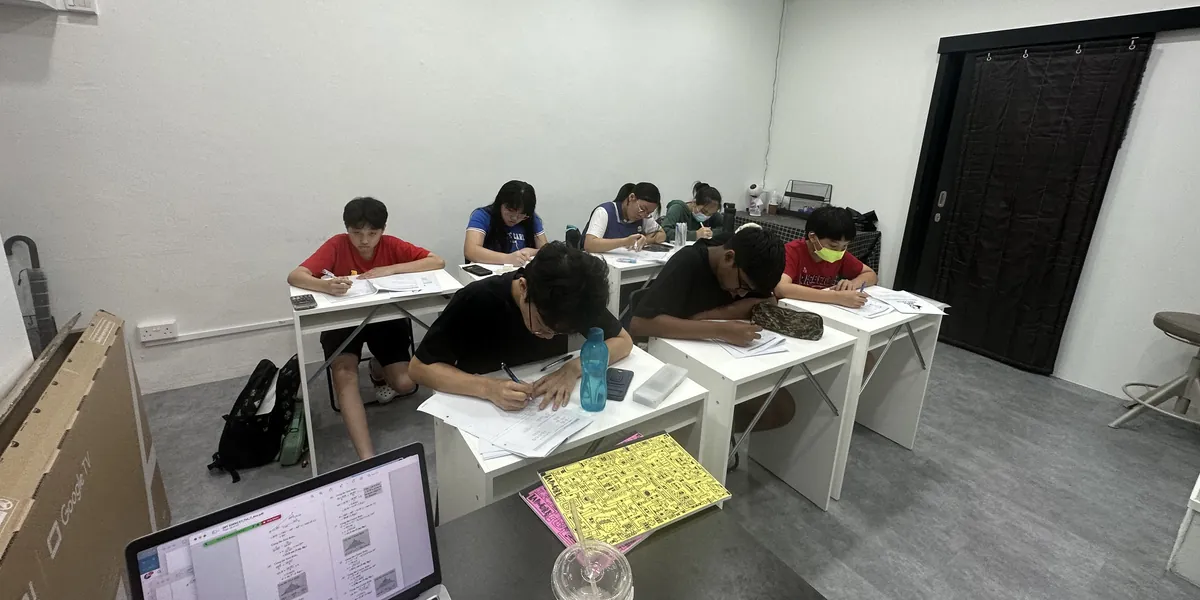
Small H2 Math classes at our Katong centre for JC1 and JC2 students. H2 Math is the subject that opens the STEM courses at university, and the one where memorised methods stop working: the A-Level asks for the why. We teach each topic with the reasoning behind the method, worked out on the screen, and train the presentation the examiners mark.
- 2 h
- once a week, in a small class
- Katong
- our JC classes run at Katong Shopping Centre
- 9758
- the A-Level H2 Mathematics syllabus we follow
Who this class is for
- JC1 students who did well in A-Math and are surprised by how fast H2 Math moves. The first term covers functions, graphs and inequalities before most students have found their feet.
- JC2 students heading for the A-Level who know the methods but lose marks on presentation, or on the questions that combine two topics.
- Students for whom vectors and complex numbers feel abstract. They are the two topics most often left for later, and the two that need the most time.
- Students who need H2 Math for a university course and want a plan for the year, not just help with this week's tutorial.
What H2 Math covers
The H2 Mathematics syllabus (SEAB 9758) is in two parts: pure mathematics, which fills JC1 and the first half of JC2, and probability and statistics. The topics are below, in the order most JCs teach them. The A-Level is two papers of 3 hours, 100 marks each.
- Functions, graphs and transformations
- Equations and inequalities
- Sequences and series
- Vectors: lines and planes
- Complex numbers
- Differentiation and its applications
- Maclaurin series
- Integration techniques and applications
- Differential equations
- Permutations, combinations and probability
- Discrete random variables and the binomial distribution
- The normal distribution
- Sampling and hypothesis testing
- Correlation and linear regression
| A-Level paper | Time and marks | What is in it |
|---|---|---|
| Paper 1 | 3 hours · 100 marks | Pure mathematics only: functions and graphs, sequences and series, vectors, complex numbers, calculus |
| Paper 2 | 3 hours · 100 marks | Section A: pure mathematics (40 marks). Section B: probability and statistics (60 marks) |
Format from SEAB's H2 Mathematics (9758) syllabus. A graphing calculator is allowed in both papers, and questions in either may be set in real-world contexts.
JC classes at Katong; new class dates on request
Our JC H2 Math classes run at the Katong centre only. Start dates for new JC1 and JC2 classes are set as students sign up, so WhatsApp us for more details and we will tell you the next available class.
Where H2 Math students usually get stuck
Every topic above has a typical way of going wrong. These are the ones we see most in class, and what we do about each. If one sounds like your child, tap the button under it and tell us; we will say what the first weeks would cover.
Pure
Functions and graphs
Where it goes wrong: Draws the graph from memory instead of from its features: asymptotes, turning points and intercepts are left off, and transformations are applied in the wrong order.
What we do: Every graph built from its features first, with the graphing calculator as a check, not the source. Transformations taught as a sequence with a rule for the order.
WhatsApp us about this topicPure
Vectors
Where it goes wrong: Vectors feel abstract. The student can compute a dot product but cannot picture a line, a plane or the foot of a perpendicular, so the question cannot be set up.
What we do: A diagram for every vectors question before any algebra, and the standard set-ups (point to line, line to plane, two planes) practised until each is recognised on sight.
WhatsApp us about this topicPure
Complex numbers
Where it goes wrong: Two forms, two sets of rules, and the student switches between them at the wrong moment. Loci and arguments are learnt as recipes and forgotten by the exam.
What we do: An Argand diagram drawn for everything, so the modulus and argument are seen, not just computed. Then the choice of form taught as a decision: which form makes this step easy?
WhatsApp us about this topicPure
Sequences and series
Where it goes wrong: Method of differences and sigma notation are memorised without the why, so a question with a small twist cannot be started.
What we do: Write out the first few terms, every time, until the pattern is seen before the formula. The formula becomes a shortcut the student understands.
WhatsApp us about this topicPure
Calculus: differentiation, integration and Maclaurin
Where it goes wrong: Knows the techniques one at a time but cannot choose between them: substitution or by parts? The Maclaurin expansion is right but the question's 'hence' part is missed.
What we do: A decision list for integration, taught and drilled. For 'hence' questions, we practise reading the question backwards: what does the last part need from the first?
WhatsApp us about this topicPure
Differential equations
Where it goes wrong: Separates the variables correctly and then loses the question in the constant of integration, or cannot turn a word problem into the equation.
What we do: Modelling questions taught from the words to the equation in a fixed order, and the constant found before any rearranging.
WhatsApp us about this topicStatistics
Probability and distributions
Where it goes wrong: Cannot tell a binomial situation from a normal one, and conditional probability is guessed. The calculator gives a number and the student does not know whether it is P(X < k) or P(X ≤ k).
What we do: The conditions for each distribution written as a checklist, and every probability question drawn as a tree, a table or a sketch before the calculator is touched.
WhatsApp us about this topicStatistics
Hypothesis testing, correlation and regression
Where it goes wrong: Follows the steps but cannot say what the conclusion means. Writes 'reject H0' with no context and loses the mark for the interpretation.
What we do: Every test ends with one sentence in the context of the question. We mark that sentence as strictly as the working.
WhatsApp us about this topicBoth papers
Presentation
Where it goes wrong: The maths is right but the marks are not: steps skipped, notation wrong, a 'show that' question that assumes what it should prove.
What we do: Model answers written the way the mark scheme expects, and the student's own working checked in class for the steps that earn the method marks.
WhatsApp us about this topicThese are the common patterns, not a list of what your child does. The trial lesson and the Post Trial Analysis & Feedback tell you which ones apply.
How we teach H2 Math
JC classes are 2 hours, in a small group, so the tutor sees how your child sets up a question, not just whether the answer is right. New topics are taught with the reasoning behind each method, because H2 Math questions change the setting and expect the student to adapt. In JC2 the class works topic by topic through past A-Level and prelim questions.
Every lesson runs in the same order, whatever the topic. Tap a step to see what it looks like in our own notes and worksheets.
A lesson, in order
The full method, including what happens at the trial and after each school test, is on The Vigilante Method.
This is what a lesson looks like
Also included
- Small classes of 2 hours, once a week, at Katong.
- Our own notes and worksheets for the 9758 syllabus, with worked examples that show the why, not just the steps.
- Help outside class: usually a class WhatsApp group with the tutor, for updates, worksheet solutions and quick questions.
- A message from the tutor after each school test, with what improved and what the class is working on next.
- We follow the topic order most JCs use. When your child's JC teaches in a different order, tell the tutor and the class covers it before the test.
From A-Math to H2 Math: what changes
Most JCs expect A-Math for H2 Math, and the first JC1 topics, functions, graphs and inequalities, build directly on it. If your child took E-Math only, tell us and we will say honestly what the catch-up would involve.
The bigger change is the kind of question. A-Math rewards a learnt method; H2 Math gives a new setting and expects the student to choose and adapt one. That is why memorising worked examples stops working in JC, and why we teach the reasoning behind every method.
What we see in class
In our experience, the students who struggle most in JC1 are often the ones who did well in A-Math by memorising. The fix is the same for everyone: slow down on the why in JC1, so that JC2 is practice rather than re-learning.
Fees
Per 4 lessons of 2 hours each, once a week, at Katong.
| Level | Fee | Lessons |
|---|---|---|
| JC1 and JC2 H2 Math, families enrolled by 31 Dec 2026 | $360 | 4 lessons of 2 h ($90 each) |
| JC1 and JC2 H2 Math, new families from 1 Jan 2027 | $380 | 4 lessons of 2 h ($95 each) |
- Families enrolled by 31 December 2026 stay on the 2026 price list for the whole of 2027; fees still follow your child's level.
- Registration fee $50, waived when your child starts by 30 November 2026 or is referred by a current Math Vigilante family.
- No deposit for families who enrol before 1 January 2027. New families from 1 January 2027 prepay four lessons, which pay for the final month when you give notice.
- Billed monthly for the lessons in that calendar month, usually 4, sometimes 5.
- Trials are paid lessons, by appointment. Your child sits in on a real class, and you receive a written Post Trial Analysis & Feedback on where the marks are being lost.
- Financial assistance (FAS) is available case by case: show us proof, and we will see what we can do, subject to availability. WhatsApp us for more info.
- No GST.
Where the classes are
JC H2 Math classes run at our Katong centre, at Katong Shopping Centre on Mountbatten Road. Start dates for new classes depend on sign-ups, so WhatsApp us for more details and the next available slot.
Hours: Monday to Friday 2:30pm to 9:30pm · Saturday and Sunday 9:00am to 6:00pm. WhatsApp 8042 6428 for the current JC H2 Math timetable, or see the class schedule.
Frequently asked questions
Which syllabus do you follow?
SEAB's H2 Mathematics syllabus, 9758, the one every JC student sits at the A-Level. Our notes follow the topic order most JCs use, and the tutor adjusts when your child's JC is on a different chapter.
When do JC classes start?
New JC1 and JC2 classes open as students sign up, so there is no fixed start date to publish. WhatsApp us for more details and we will tell you the next available class at Katong.
My child is in JC2. Is it too late to join?
No. The JC2 class works topic by topic through past A-Level and prelim questions, so a student who joins in JC2 revises every topic in the exam's own format. Tell us the topics your child finds hardest and we will say what the first weeks would cover.
Does my child need A-Math for H2 Math?
Most JCs expect A-Math for H2 Math, and the first JC1 topics build on it. If your child took E-Math only, tell us; we will say honestly what the catch-up would involve before you decide anything.
Do you run JC classes at Hougang?
Not at the moment. JC H2 Math classes run at our Katong centre, at Katong Shopping Centre on Mountbatten Road. If you are in the north-east, WhatsApp us; we will tell you the Katong slots and keep your details for when a Hougang class opens.
How big are the classes?
Typically 2 to 6 students. Popular classes at Katong can go up to 9.
We keep classes small so that every student gets enough attention from the tutor, especially since we track each student's progress and check how they present their working.
How long is a lesson?
One lesson a week.
- P3 to P4:1.5 hours
- P5 to P6:2 hours
- S1 to S4/5:2 hours
- JC1 to JC2:2 hours
Is the trial lesson free?
No, and here is why.
Our classes are small, so your child is not an extra seat in a big room. On trial day your child gets the same tutor, the same attention and the same notes and worksheets as every other student, and the tutor plans around your child from the first lesson.
A big centre can give away a free seat because one more child in a hall of forty changes nothing for them. For us, every seat is a real lesson.
So you pay the normal lesson fee, your child sits in a real class, and afterwards you get the written Post Trial Analysis & Feedback. You will know exactly where your child stands before you decide anything.
What if my child is far behind?
That is what the trial is for. The Post Trial Analysis & Feedback names the exact topics and question types costing marks, and the class works through those first.
Classes are small, so the tutor sees how your child works, not just the final answer.
Private 1-to-1 lessons during the school holidays are available, subject to availability.
Can my child ask questions outside class?
Yes. Most classes have a WhatsApp group with the tutor.
We use it for class updates and worksheet solutions, and your child can ask questions there so the whole class learns from the answer.
Your child can also message the tutor for help with a few questions, for example two or three just before a test. Tutors reply when they are free, usually within a day.
Please be reasonable: our tutors are not expected to mark your child's school work. They help with it out of goodwill when they are free.
What if my child misses a lesson?
Tell us at least 24 hours before, or send an MC within 48 hours if your child is ill, and we fit your child into another class with space. The make-up tutor gets a lesson plan of where your child stopped, so nothing is skipped.
Make-ups are taken within 21 days, with up to 2 waiting at a time. If no class has space, your child still gets that lesson's notes and worksheets.
A no-show, or a cancellation with less than 24 hours' notice, is charged in full and has no make-up.
How will I know if it is working?
After every school test, the tutor messages you with what improved and what the class is working on next.
Every child is different, so we tell you what is happening rather than promise a grade.
One thing to know: students sometimes forget to show the tutor their exam papers, and without the paper the tutor cannot work out what went wrong.
If you have not heard from the tutor, feel free to reach out to us or the tutor and ask for a termly feedback.
Is there a registration fee?
$50, paid once when your child joins.
It is not a yearly or monthly charge. It never comes up again until your child graduates from Math Vigilante.
Waived for families who start by 30 November 2026, and for anyone referred by a current Math Vigilante family.
There are no material or printing fees.
Is there a deposit?
It depends on when your child enrols.
- Enrolment before 1 January 2027:no deposit.
- Enrolment from 1 January 2027:new families prepay four lessons.
That deposit pays for the final month when you give notice.
Will our fees go up in 2027?
Not because of the 2027 price change, as long as your child is enrolled by 31 December 2026 and lessons continue without a break. Those families stay on the 2026 price list for the whole of 2027.
Fees still follow your child's level. A child moving from Sec 2 to Sec 3 pays the Sec 3 fee on the 2026 list ($70 to $75 a lesson).
New families from 1 January 2027 pay the 2027 list, $5 more a lesson.
How do I start?
WhatsApp us at 8042 6428 with your child's level, school and latest Math result.
We suggest a class and a time at the nearest centre, usually within a day.
Ask about JC H2 Math at Katong
Tell us your child's JC, year and the topics they find hardest. We will tell you the next available class at Katong, and after a trial lesson you get a written Post Trial Analysis & Feedback.
WhatsApp 8042 6428Or email hello@mathvigilante.com.
Related
- Sec 4 A-Math tuition — the foundation H2 Math builds on
- What is A-Math? — A-Math vs E-Math, and why JC H2 Math expects it
- L1R4 calculator — JC eligibility under the SEC rules
- The Vigilante Method: how every lesson runs
- Results from our students
- Our Katong centre
- Private 1-to-1 coaching with Mr Lai
Fees shown are our current rates and may change; the fee quoted when you enrol applies. Results shown are individual students' results and are not a promise of any grade. Math Vigilante is a private tuition centre and is not affiliated with MOE or SEAB.