Home / P3 and P4 Math Tuition
Primary 3 and 4 · Standard Math · Katong and Hougang
P3 and P4 Math Tuition in Singapore
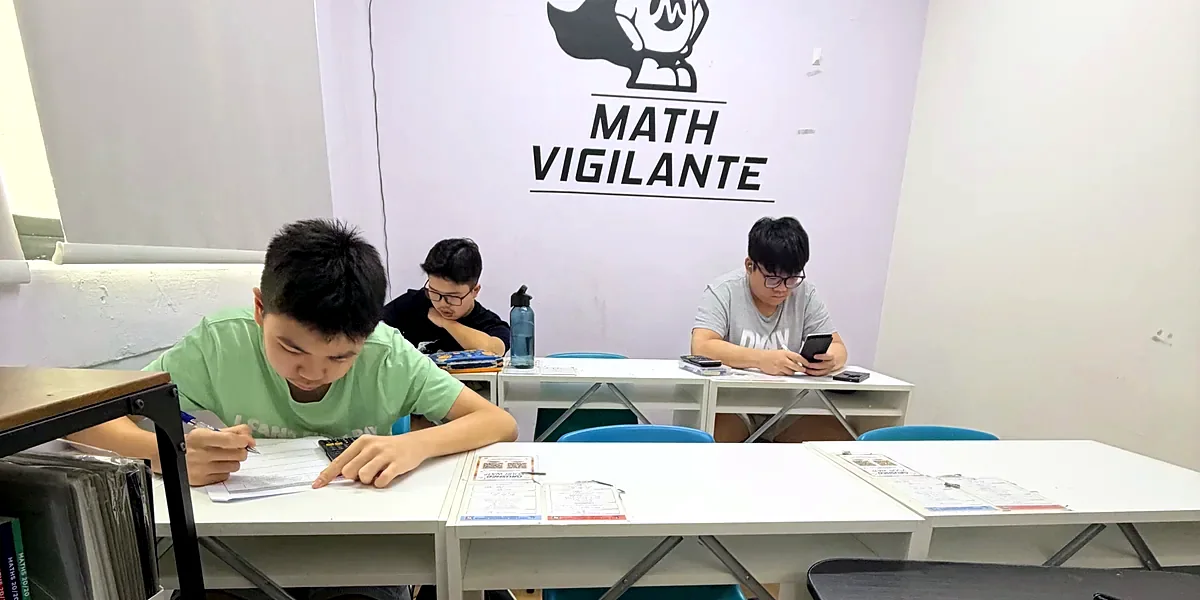
Small P3 and P4 Math classes at our Katong and Hougang centres, 1.5 hours once a week. These two years build the number sense, the times tables and the model drawings that every PSLE question will lean on. We teach each topic in MOE's order, worked out on the screen, and we tell you where your child is losing marks.
- 1.5 h
- once a week, in a small class
- $45
- a lesson, billed monthly, no GST
- 2 areas
- Katong and Hougang both run primary classes
Who this class is for
- P3 students meeting the first big jumps: numbers to 10 000, multiplication and division, and fractions. If the times tables are not automatic yet, this is the year to fix it.
- P4 students who find the sums fine but freeze at word problems. P4 is where school papers start asking two-step questions, and the model drawing has to carry the thinking.
- Children who get the answer in their head but cannot show how. The longer questions carry marks for the working, and we train that early.
- Parents who want P5 to start calmly. P5 brings percentage, rate and the full fraction work in one year, and all of them assume the P4 work is automatic.
What P3 and P4 Math covers
MOE's 2021 Primary Mathematics syllabus runs in three strands: number and algebra, measurement and geometry, and statistics. P3 and P4 are the foundation years: the four operations with bigger numbers, fractions, decimals from P4, and the measurement topics school papers love. The list below is both years in full, in the order most schools teach it.
- P3: Numbers to 10 000
- P3: Addition and subtraction to 10 000
- P3: Multiplication and division, with the tables of 6, 7, 8 and 9
- P3: Fractions: equivalent fractions, adding and subtracting like fractions
- P3: Money: dollars and cents
- P3: Time: hours and minutes, the 24-hour clock, how long something takes
- P3: Length, mass and volume: km, m and cm; kg and g; litres and ml
- P3: Area and perimeter
- P3: Angles, and perpendicular and parallel lines
- P3: Bar graphs
- P4: Numbers to 100 000
- P4: Factors and multiples
- P4: The four operations with bigger numbers
- P4: Fractions: mixed numbers, improper fractions, adding and subtracting related fractions
- P4: Decimals to 3 decimal places, and the four operations with them
- P4: Area and perimeter of composite figures
- P4: Symmetry
- P4: Angles in degrees
- P4: Tables, line graphs and pie charts
- P4: Nets of cubes and cuboids
| Year | How school tests it | What the papers lean on |
|---|---|---|
| Primary 3 | Weighted assessments during the year and an end-of-year exam, set by the school | The four operations, fractions, money and time; word problems in one or two steps |
| Primary 4 | Weighted assessments and an end-of-year exam, set by the school | Fractions and decimals, factors and multiples, area and perimeter; two-step word problems with model drawing |
There is no national exam before the PSLE. Schools set their own weighted assessments and end-of-year exam (mid-year exams were removed from 2023); check your child's school assessment plan for the exact dates and weightings.
Why start at P3?
P3 is when primary math stops being counting and starts being method: times tables, fractions and the first model drawings. A child who leaves P4 with those automatic finds P5 percentage and P6 ratio far less scary. Already in P5 or P6? See our P5 and P6 PSLE Math page.
Where P3 and P4 students usually get stuck
Every topic above has a typical way of going wrong. These are the ones we see most in class, and what we do about each. If one sounds like your child, tap the button under it and tell us; we will say which class fits.
P3
Times tables and division
Where it goes wrong: The tables for 6, 7, 8 and 9 are not automatic, so every multiplication or division question is slow, and the child runs out of time for the word problems.
What we do: Short drills in class until recall is instant, then division taught as the same table in reverse, so one fact serves both.
WhatsApp us about this topicP3
Word problems: add or subtract?
Where it goes wrong: Reads the question, sees two numbers and adds when it should subtract, or the other way round. The sums are right; the choice of operation is not.
What we do: Draw the model first and decide from the picture, not from a guess. The same steps every time, until it is a habit.
WhatsApp us about this topicP3
Fractions
Where it goes wrong: Treats the top and bottom numbers as two separate sums: adds 1/4 and 1/4 and gets 2/8.
What we do: Fraction strips and shading before any rule, so the child sees that quarters stay quarters. Equivalent fractions are taught as the same piece cut smaller.
WhatsApp us about this topicP3
Time and money
Where it goes wrong: Counts time like an ordinary number (1 h 70 min is left as it is) and lines up dollars and cents in the wrong column.
What we do: A timeline for every duration question and one fixed layout for money, practised until the layout is automatic.
WhatsApp us about this topicP4
Factors and multiples
Where it goes wrong: Mixes the two up, and lists them by guessing rather than by a method, so the common factor or common multiple goes missing.
What we do: One listing method the child can rely on, and the words tied to the action: factors divide into a number, multiples count up from it.
WhatsApp us about this topicP4
Fractions: should the answer be bigger or smaller?
Where it goes wrong: Cannot tell whether an answer should be bigger or smaller than the number they started with, so a wrong answer never looks wrong. Mixed numbers and improper fractions get muddled.
What we do: Estimate first, then calculate. The child says whether the answer should grow or shrink before any working, and converts mixed numbers the same way every time.
WhatsApp us about this topicP4
Decimals
Where it goes wrong: Lines up 3.5 and 3.25 by the last digit, so the sum is wrong. Multiplying or dividing by 10 and 100 moves the point the wrong way.
What we do: Place-value charts until the decimal point is the anchor, then the four operations one at a time with the same layout.
WhatsApp us about this topicP4
Area and perimeter of composite figures
Where it goes wrong: Finds the area of an L-shape but forgets that the perimeter needs the sides the question did not give, or adds the missing lengths without working them out.
What we do: Cut-and-add or whole-minus-hole for area. For perimeter, label every side first, including the hidden ones.
WhatsApp us about this topicP4
Two-step word problems
Where it goes wrong: Finds the first number and stops, or finds it and does not know what to do with it. The model is drawn but not used.
What we do: Model drawing taught as the tool that answers the question, not as decoration: draw, label what you know, mark what you want, then write the steps from the model.
WhatsApp us about this topicThese are the common patterns, not a list of what your child does. The trial lesson and the Post Trial Analysis & Feedback tell you which ones apply.
How we teach P3 and P4 Math
Primary classes are small, so the tutor sees how your child works, not just the answer. Each lesson is 1.5 hours: long enough to teach one idea properly and practise it, short enough for a P3 child to stay with it.
Every lesson runs in the same order, whatever the topic. Tap a step to see what it looks like in our own notes and worksheets.
A lesson, in order
The full method, including what happens at the trial and after each school test, is on The Vigilante Method.
This is what a lesson looks like
Also included
- Small classes of 1.5 hours, once a week, at Katong or Hougang.
- Our own notes and worksheets, following the MOE primary syllabus, with the model method taught from P3.
- Help outside class: usually a class WhatsApp group with the tutor, for updates, worksheet solutions and quick questions.
- A message from the tutor after each school test, with what improved and what the class is working on next.
- We follow MOE's order of topics. When a school teaches in a different order, tell the tutor and the class covers it before the test.
From P4 to P5: what changes
P5 is the biggest jump in primary math. Lessons move to 2 hours, and percentage, rate and the multiplying and dividing of fractions all arrive in one year, with ratio and algebra following in P6. Every one of them assumes the P4 work is automatic: tables, fractions, decimals and model drawing.
At the end of P4, schools also decide whether a pupil takes Standard or Foundation Math from P5; our classes teach Standard Math only.
What we see in class
In our experience, the P4 students who go on to do well in P5 are not the ones who did the most worksheets. They are the ones whose tables, fraction sense and model drawing became automatic, so P5 percentage and P6 ratio feel like a new use of an old tool. That is what we aim for by the end of P4.
Fees
Per 4 lessons of 1.5 hours each, once a week. The same rate at Katong and Hougang.
| Level | Fee | Lessons |
|---|---|---|
| P3 and P4, families enrolled by 31 Dec 2026 | $180 | 4 lessons of 1.5 h ($45 each) |
| P3 and P4, new families from 1 Jan 2027 | $200 | 4 lessons of 1.5 h ($50 each) |
- Families enrolled by 31 December 2026 stay on the 2026 price list for the whole of 2027; fees still follow your child's level.
- Registration fee $50, waived when your child starts by 30 November 2026 or is referred by a current Math Vigilante family.
- No deposit for families who enrol before 1 January 2027. New families from 1 January 2027 prepay four lessons, which pay for the final month when you give notice.
- Billed monthly for the lessons in that calendar month, usually 4, sometimes 5.
- Trials are paid lessons, by appointment. Your child sits in on a real class, and you receive a written Post Trial Analysis & Feedback on where the marks are being lost.
- Financial assistance (FAS) is available case by case: show us proof, and we will see what we can do, subject to availability. WhatsApp us for more info.
- No GST.
Where the classes are
P3 and P4 classes run at Katong and at Hougang. Timetables change each term, so we do not list days and times here: WhatsApp us to check the current slots, and tell us your child's school so we can place them with children at the same point in the syllabus.
Hours: Monday to Friday 2:30pm to 9:30pm · Saturday and Sunday 9:00am to 6:00pm. WhatsApp 8042 6428 for the current P3 and P4 Math timetable at each centre, or see the class schedule.
Frequently asked questions
Is P3 too early for tuition?
Not if the aim is a calm P5. P3 is when primary math turns from counting into method: times tables, fractions and the first model drawings. A child who leaves P4 with those automatic has a much easier P5 and P6. If your child is already doing well, the class stretches them with the harder question types and builds the working habits the PSLE will need.
Do you teach the model method?
Yes, from P3. Model drawing is the main problem-solving tool in primary school, and the tool P6 ratio and algebra questions are built on. We teach it as a method that produces the answer, not as a drawing to add afterwards.
Which syllabus do you follow?
MOE's 2021 Primary Mathematics syllabus, in MOE's order. Our notes and worksheets are our own, written to that syllabus and to the question types school papers use.
How big are the classes?
Typically 2 to 6 students. Popular classes at Katong can go up to 9.
We keep classes small so that every student gets enough attention from the tutor, especially since we track each student's progress and check how they present their working.
How long is a lesson?
One lesson a week.
- P3 to P4:1.5 hours
- P5 to P6:2 hours
- S1 to S4/5:2 hours
- JC1 to JC2:2 hours
My school teaches topics in a different order. Does that matter?
Our notes follow MOE's syllabus order.
If your child's school is on a different chapter, tell the tutor.
Classes are small, so the tutor covers it with your child, especially in the weeks before a test.
Is the trial lesson free?
No, and here is why.
Our classes are small, so your child is not an extra seat in a big room. On trial day your child gets the same tutor, the same attention and the same notes and worksheets as every other student, and the tutor plans around your child from the first lesson.
A big centre can give away a free seat because one more child in a hall of forty changes nothing for them. For us, every seat is a real lesson.
So you pay the normal lesson fee, your child sits in a real class, and afterwards you get the written Post Trial Analysis & Feedback. You will know exactly where your child stands before you decide anything.
What if my child is far behind?
That is what the trial is for. The Post Trial Analysis & Feedback names the exact topics and question types costing marks, and the class works through those first.
Classes are small, so the tutor sees how your child works, not just the final answer.
Private 1-to-1 lessons during the school holidays are available, subject to availability.
Which centre should we go to?
Whichever is nearer to you. Tell us where you live and we match the class to the nearest room.
- Katong:Katong Shopping Centre, 865 Mountbatten Road #02-77, Singapore 437844.
About 8 minutes' walk from Tanjong Katong MRT.
Buses 10, 12, 14, 32, 40 and 47 stop right outside. - Hougang Central:806 Hougang Central #03-144, Singapore 530806.
Next to Hougang MRT and the bus interchange. - Hougang, opposite the CC:Blk 19 Hougang Avenue 3 #01-185, Singapore 530019.
About 10 minutes' walk from Hougang or Kovan MRT.
Buses 25, 51, 55, 62, 72, 81, 115 and 854 stop at Blk 21, right outside.
Can my child ask questions outside class?
Yes. Most classes have a WhatsApp group with the tutor.
We use it for class updates and worksheet solutions, and your child can ask questions there so the whole class learns from the answer.
Your child can also message the tutor for help with a few questions, for example two or three just before a test. Tutors reply when they are free, usually within a day.
Please be reasonable: our tutors are not expected to mark your child's school work. They help with it out of goodwill when they are free.
What if my child misses a lesson?
Tell us at least 24 hours before, or send an MC within 48 hours if your child is ill, and we fit your child into another class with space. The make-up tutor gets a lesson plan of where your child stopped, so nothing is skipped.
Make-ups are taken within 21 days, with up to 2 waiting at a time. If no class has space, your child still gets that lesson's notes and worksheets.
A no-show, or a cancellation with less than 24 hours' notice, is charged in full and has no make-up.
How will I know if it is working?
After every school test, the tutor messages you with what improved and what the class is working on next.
Every child is different, so we tell you what is happening rather than promise a grade.
One thing to know: students sometimes forget to show the tutor their exam papers, and without the paper the tutor cannot work out what went wrong.
If you have not heard from the tutor, feel free to reach out to us or the tutor and ask for a termly feedback.
Is there a registration fee?
$50, paid once when your child joins.
It is not a yearly or monthly charge. It never comes up again until your child graduates from Math Vigilante.
Waived for families who start by 30 November 2026, and for anyone referred by a current Math Vigilante family.
There are no material or printing fees.
Is there a deposit?
It depends on when your child enrols.
- Enrolment before 1 January 2027:no deposit.
- Enrolment from 1 January 2027:new families prepay four lessons.
That deposit pays for the final month when you give notice.
Will our fees go up in 2027?
Not because of the 2027 price change, as long as your child is enrolled by 31 December 2026 and lessons continue without a break. Those families stay on the 2026 price list for the whole of 2027.
Fees still follow your child's level. A child moving from Sec 2 to Sec 3 pays the Sec 3 fee on the 2026 list ($70 to $75 a lesson).
New families from 1 January 2027 pay the 2027 list, $5 more a lesson.
How do I start?
WhatsApp us at 8042 6428 with your child's level, school and latest Math result.
We suggest a class and a time at the nearest centre, usually within a day.
Book a P3 or P4 Math trial lesson
Tell us your child's level, school and the topics they find hard. We will suggest a class and a time at Katong or Hougang, and after the trial you get a written Post Trial Analysis & Feedback.
WhatsApp 8042 6428Or email hello@mathvigilante.com.
Related
- P5 and P6 PSLE Math tuition
- The Vigilante Method: how every lesson runs
- Results from our students
- Our Katong centre
- Our Hougang centres
- Every question parents ask us, in one place
Fees shown are our current rates and may change; the fee quoted when you enrol applies. Results shown are individual students' results and are not a promise of any grade. Math Vigilante is a private tuition centre and is not affiliated with MOE or SEAB.