Home / Free Resources
N-Level A-Math 2026 Paper 1 Answers (4051/01)
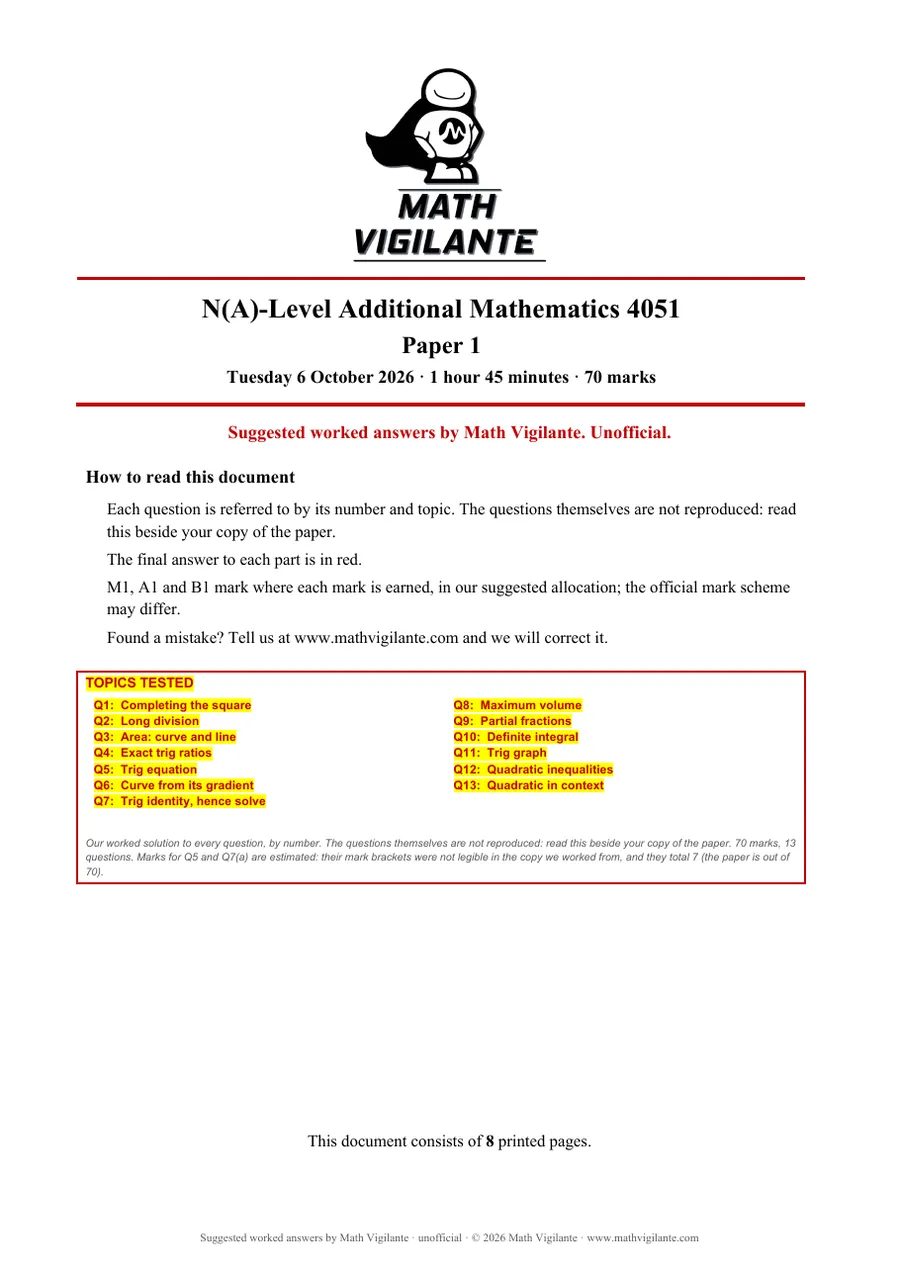
Our suggested answers to the 2026 N(A)-Level Additional Mathematics Paper 1 (4051/01), sat on Tuesday 6 October 2026: all 13 questions, 70 marks.
Every answer was worked out by our tutors, checked line by line with computer algebra, and re-solved independently in a separate review. The PDF shows our full working for every question, by question number, with the marks we expect each step to earn; the questions themselves are not reproduced.
Download the worked solutions (PDF, 8 pages)Unofficial — not SEAB’s answer key. Full disclaimer below.
Preview: 3 of 10 pages
Swipe to see more →
Answers at a glance
22 parts, 70 marks. The PDF has the full working for every part.
Watch the working, not just the answer: in Q5, never divide by sin θ (you lose 0°, 180° and 360°); in Q8(b), factorise dV/dr = 3πr(8 − 3r) instead of dividing by r; in Q12, “≤ 0” keeps the end point −3.
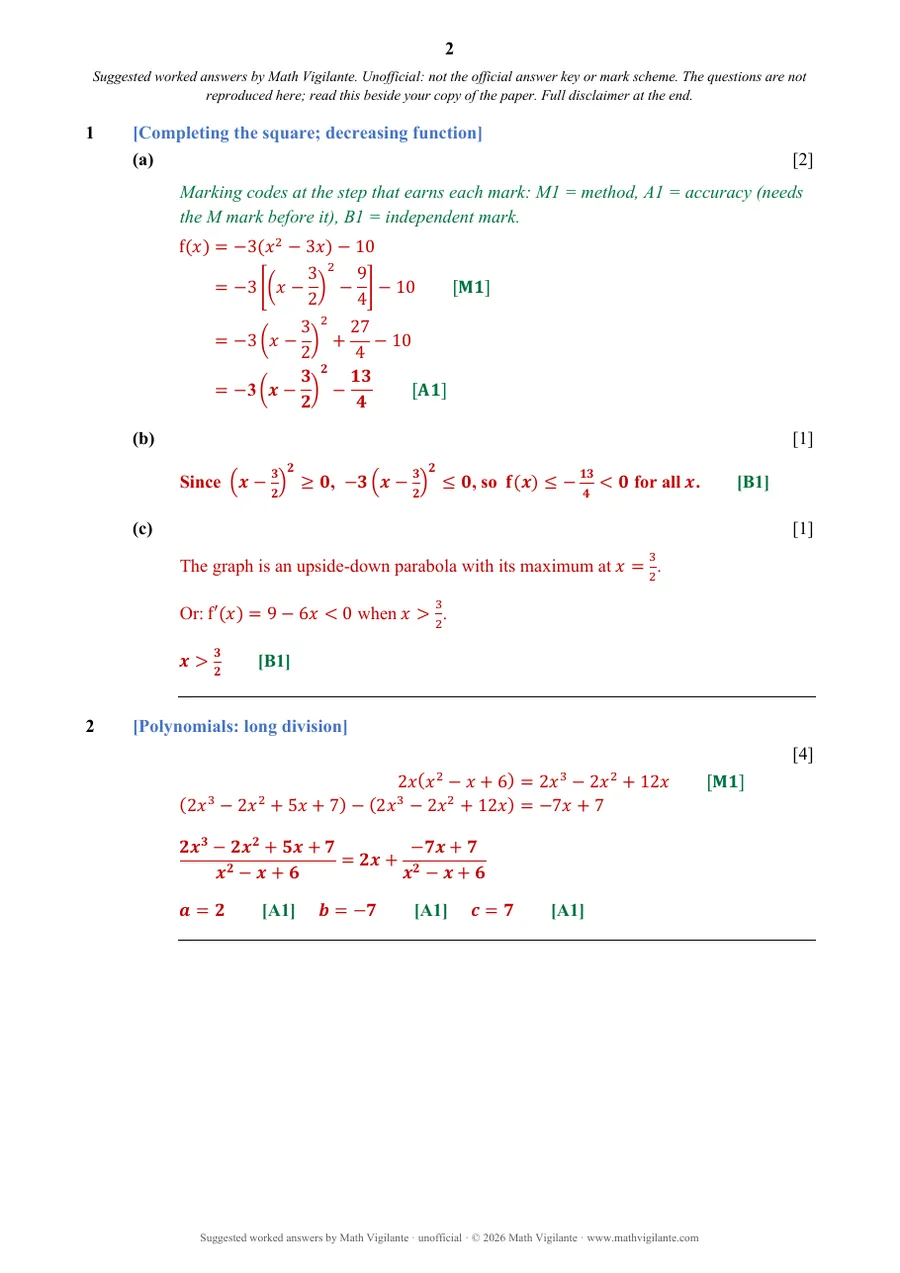
Q1(a) · Completing the square · [2]
f(x) = −3(x − 3/2)2 − 13/4
Q1(b) · Always negative · [1]
(x − 3/2)2 ≥ 0, so f(x) ≤ −13/4 < 0 for all x
Q1(c) · Decreasing function · [1]
x > 3/2
Q2 · Polynomial long division · [4]
2x + (−7x + 7)/(x2 − x + 6): a = 2, b = −7, c = 7
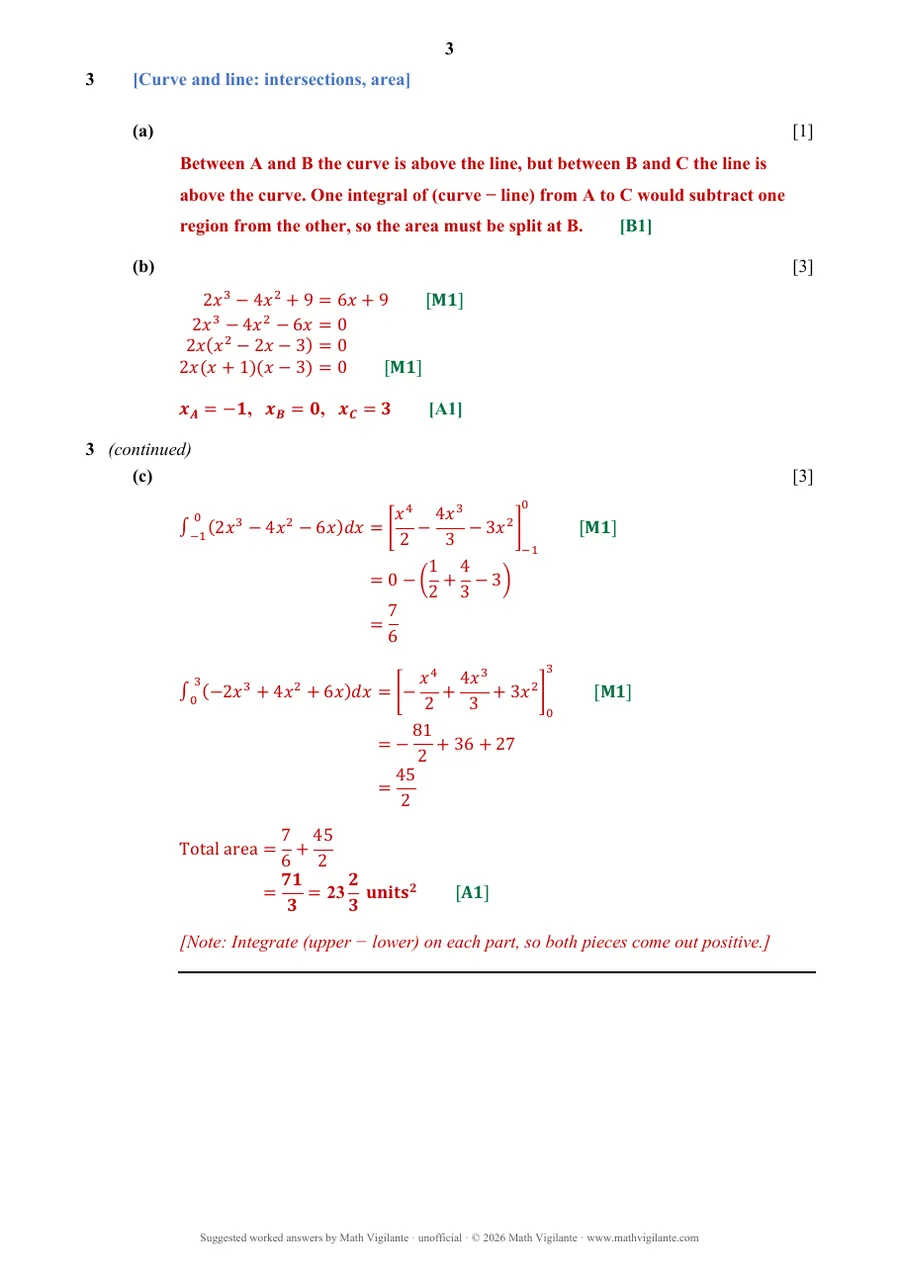
Q3(a) · Area between a curve and a line · [1]
The curve is above the line from A to B but below it from B to C, so one integral would subtract one region from the other
Q3(b) · Intersections of a curve and a line · [3]
x = −1, 0, 3
Q3(c) · Area between a curve and a line · [3]
7/6 + 45/2 = 71/3 = 23⅔ units2
Q4(a) · Exact trig ratios (no calculator) · [3]
sec θ = √5/2
Q4(b) · Compound angle formula · [2]
tan(θ + 45°) = 3
Q5 · Trig equation (marks estimated) · [4]
θ = 0°, 120°, 180°, 240°, 360°
Q6 · Equation of a curve from its gradient · [6]
k = 1/4; y = (5/12)x3 − (1/4)x2 + 2/3
Q7(a) · Trig identity, show that (marks estimated) · [3]
(sin2θ + cos2θ)/(sin θ cos θ) = 2/(2 sin θ cos θ) = 2/sin 2θ (shown)
Q7(b) · Hence solve · [3]
θ = 15°
Q8(a) · Similar triangles (show that) · [3]
h = 12 − 3r, so V = πr2(12 − 3r) = 3π(4r2 − r3) (shown)
Q8(b) · Maximum volume · [6]
r = 8/3; V = 256π/9 ≈ 89.4 cm3
Q9 · Partial fractions · [4]
5/(x + 2) − 4/(3x + 1)
Q10 · Definite integral · [4]
119/6
Q11(a) · Sketching a trig graph · [3]
Cosine shape: maximum (0, 2), minimum −6 at x = ±π/3, crosses the x-axis at x = ±π/9
Q11(b) · Period and amplitude · [2]
Period 2π/3, amplitude 4
Q12 · Quadratic inequalities · [6]
−3 ≤ x < −4/3 (closed circle at −3, open circle at −4/3)
Q13(a) · Forming an equation (show that) · [2]
2πx + 2πr = 32π, so r = 16 − x (shown)
Q13(b) · Quadratic equation in context · [4]
Radii 6 cm and 10 cm, so the pieces are 12π ≈ 37.7 cm and 20π ≈ 62.8 cm
Topics tested in Paper 1
- Quadratics: completing the square, always negative, quadratic inequalities, a quadratic problem in context
- Polynomials and partial fractions: long division, partial fractions
- Trigonometry: exact ratios without a calculator, compound angles, a trig equation, an identity then “hence” solve, sketching y = a + b cos cx with its period and amplitude
- Calculus: decreasing functions, maximum volume, the equation of a curve from its gradient, a definite integral, the area between a curve and a line
What this means for Paper 2
Paper 1 did NOT test the R-formula, the coordinate geometry of circles, surd manipulation (answers like a + b√c), the remainder and factor theorem, the discriminant for a line meeting a curve, tangents and normals, connected rates of change or the nature of stationary points. Those are the ones to make sure of for Paper 2.
Topics that came out in Paper 1 can still come back in a new form: an identity in radians instead of degrees, or rates of change instead of a maximum. Revise every topic, starting with the ones Paper 1 skipped.
Paper 2 answers are up: N-Level A-Math 2026 Paper 2 Answers (4051/02). Seven of the eight topics above came out in Paper 2. Our pre-exam Paper 2 forecast is still up. Our N-Level Math programme covers E-Math and A-Math, topic by topic.
WhatsApp us about N-Level A-MathFrequently asked questions
Are these the official N-Level 2026 A-Math Paper 1 answers?
No. SEAB does not publish answer keys or mark schemes. These are Math Vigilante’s own suggested answers, carefully checked, and the marks shown are our suggested allocation. Your result is decided by SEAB’s marking alone.
Why are the marks for Q5 and Q7(a) marked as estimates?
The copy of the paper we worked from had those two mark brackets covered. The paper totals 70 marks and every other part is known, so Q5 and Q7(a) add up to 7; we have used 4 and 3.
Does the PDF include the questions?
No. The PDF shows our worked solution to every question, by question number, with the marks we expect each step to earn. The questions themselves are not reproduced, so read it beside your copy of the paper. The question paper remains © Cambridge University Press & Assessment and the Ministry of Education, Singapore.
What do M1, A1 and B1 mean in the worked solutions?
They show where each mark is usually earned. M1 is a method mark for a correct method, A1 an accuracy mark for a correct answer that follows from that method, and B1 an independent mark for a correct fact or answer.
I think one of your answers is wrong. What should I do?
Please tell us on WhatsApp at +65 8042 6428. We check every report and correct the page and the PDF if we find a mistake.
Disclaimer and copyright
Unofficial suggested answers. This page is not produced, reviewed or endorsed by the Singapore Examinations and Assessment Board (SEAB), the Ministry of Education (MOE) or Cambridge University Press & Assessment, and it is not SEAB’s answer key or mark scheme. SEAB, MOE and Cambridge are named only to identify the examination.
The question paper is © Cambridge University Press & Assessment and the Ministry of Education, Singapore, 2026, and all rights in it remain with them. The downloadable PDF does not reproduce the question paper: questions are referred to by number and topic, and it carries none of SEAB’s or Cambridge’s cover pages. If you hold rights in this examination and object to any part of this page or the PDF, contact us through WhatsApp at +65 8042 6428 and we will take it down promptly.
Every answer has been checked, but errors may remain, and Math Vigilante accepts no liability for any loss arising from their use. The answers and explanations are © 2026 Math Vigilante.