Home / Free Resources
N-Level Math 2026 Paper 2 Answers (4045/02)
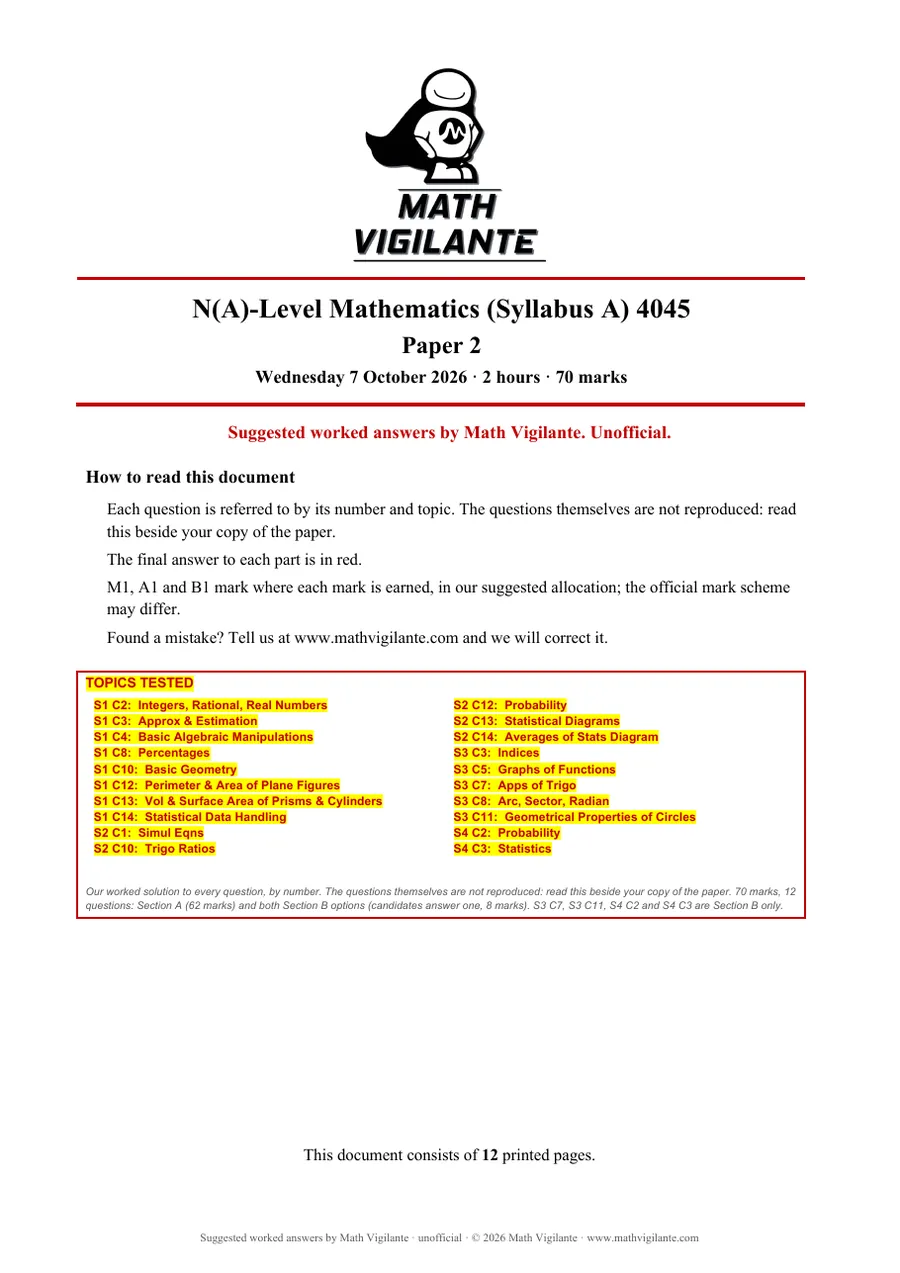
Our suggested answers to the 2026 N(A)-Level Mathematics Paper 2 (4045/02), sat on Wednesday 7 October 2026: all 12 questions, including both Section B options.
Every answer was worked out by our tutors, checked line by line with computer algebra, and re-solved independently in a separate review. The PDF shows our full working for every question, by question number, with the marks we expect each step to earn; the questions themselves are not reproduced. Graph readings are given to the accuracy a marker accepts (about ±0.1).
Download the worked solutions (PDF, 12 pages)Unofficial — not SEAB’s answer key. Full disclaimer below.
Preview: 3 of 13 pages
Swipe to see more →
Answers at a glance
40 parts. Section A is 62 marks; in Section B you answer one of the two questions (8 marks each), so the paper is out of 70.
Section B: candidates answer ONE of Questions 11 and 12. We have answered both, so check the one you chose.
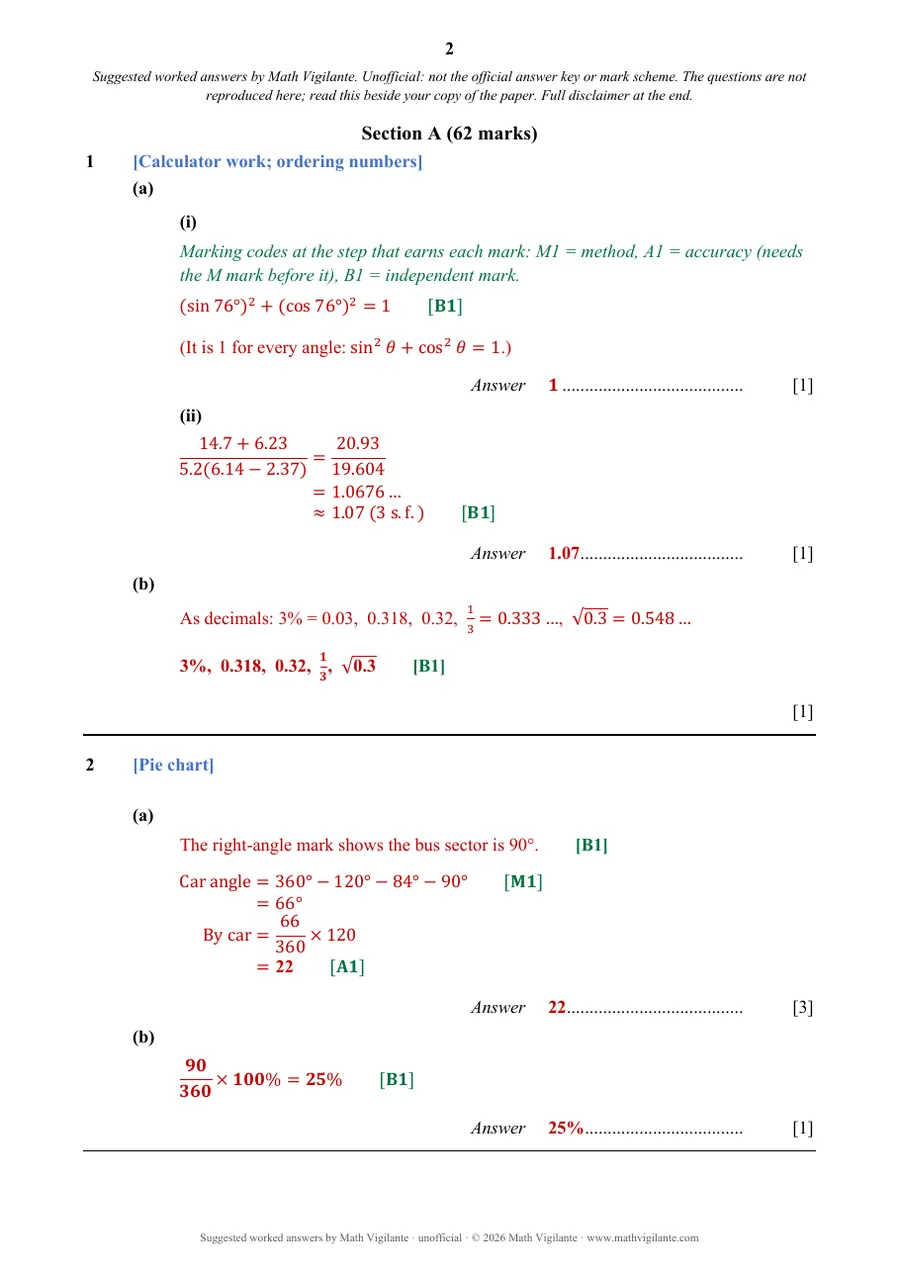
Q1(a)(i) · Calculator work (trigonometry) · [1]
1
Q1(a)(ii) · Calculator work · [1]
1.07
Q1(b) · Ordering numbers · [1]
3%, 0.318, 0.32, 1/3, √0.3
Q2(a) · Pie chart · [3]
22 students (car angle = 66°)
Q2(b) · Pie chart (percentage) · [1]
25%
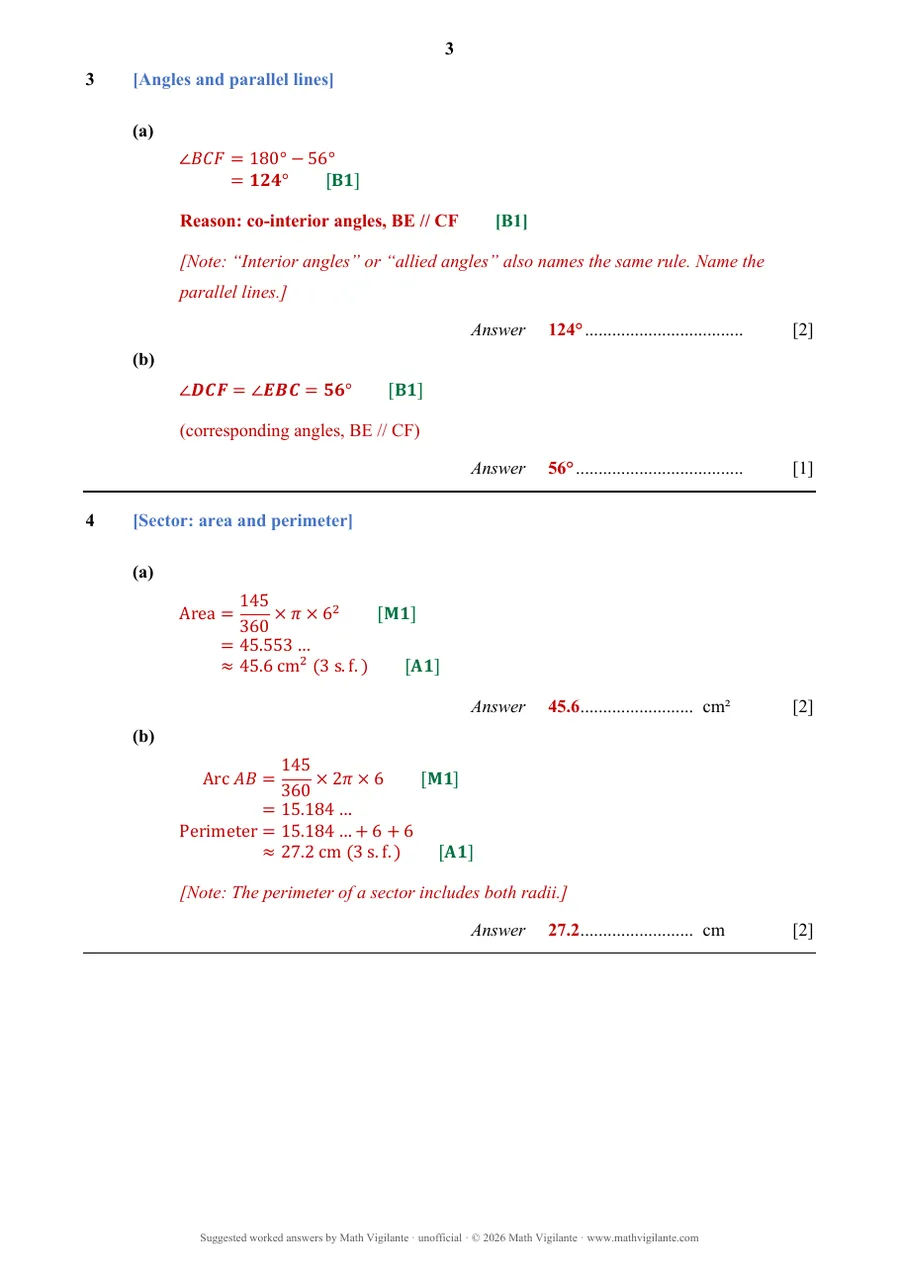
Q3(a) · Angles and parallel lines · [2]
124° (co-interior angles, BE // CF)
Q3(b) · Angles and parallel lines · [1]
56° (corresponding angles, BE // CF)
Q4(a) · Area of a sector · [2]
45.6 cm²
Q4(b) · Perimeter of a sector · [2]
27.2 cm
Q5(a)(i) · Expanding brackets · [2]
6x + 35
Q5(a)(ii) · Laws of indices · [1]
a6
Q5(a)(iii) · Negative and fractional indices · [2]
q / (4p3)
Q5(b) · Simultaneous equations · [4]
x = 2, y = −3
Q6(a) · Simple interest · [3]
$2688
Q6(b) · Compound interest · [2]
$4394.72
Q6(c) · Compound interest (finding the rate) · [3]
r = 2.20
Q7(a) · Histograms · [1]
A histogram shows the shape (distribution) of continuous data
Q7(b) · Median of grouped data · [1]
The median is the mean of the 25th and 26th values. Cumulative frequencies 12 then 27 put both in 15 < t ≤ 20, not 20 < t ≤ 25: the groups have different frequencies, so the middle group is not the median group
Q7(c) · Mean of grouped data · [2]
20.1 minutes
Q7(d) · Probability · [1]
6/25
Q8(a) · Trigonometry (show that) · [3]
DC = 12 − 2(7 cos 72°) ≈ 7.674 ≈ 7.67 cm (shown)
Q8(b) · Area of a trapezium · [3]
65.5 cm²
Q8(c) · Volume of a prism · [1]
982 cm³
Q9(a) · Table of values (cubic) · [2]
y = −21 at x = −2; y = 7 at x = 5
Q9(b) · Drawing a cubic graph · [3]
Smooth curve through all ten plotted points
Q9(c) · Reading a graph (minimum) · [1]
−11.5
Q9(d) · Gradient from a graph · [1]
0 < x < 3.3
Q9(e) · Solving an equation with a graph · [3]
x ≈ −0.7, 0.85, 4.9 (each ±0.1)
Q10(a) · Standard form and units · [2]
1.585 × 10¹⁰ litres
Q10(b) · Volume ÷ area (average depth) · [2]
9.14 m
Q10(c)(i) · Estimation (total daily water usage) · [3]
1.99 × 10⁶ m³
Q10(c)(ii) · Percentage · [2]
66.4% (use the unrounded total; 1.99 × 10⁶ gives 66.3%)
Q11(a) · Section B · Tangents to a circle · [2]
Tangents from an external point are equal, so PA = PB. Triangle PAB is isosceles, so angle PAB = angle PBA
Q11(b) · Section B · Angle properties of circles · [2]
126° (angle ABC = 54°: angle at centre = 2 × angle at circumference; angles in opposite segments add up to 180°)
Q11(c) · Section B · Sine rule (angles of elevation) · [4]
PH ≈ 3650 m
Q12(a)(i) · Section B · Comparing distributions · [1]
Athlete A: lower median time (53.2 s < 55.7 s), so A usually takes less time
Q12(a)(ii) · Section B · Comparing distributions · [1]
Athlete B: smaller interquartile range (4.7 s < 5.2 s), so B’s times are less spread out
Q12(b) · Section B · Standard deviation · [2]
6.96 m
Q12(c)(i) · Section B · Probability without replacement · [2]
1/55
Q12(c)(ii) · Section B · Probability without replacement · [2]
1/165
Topics tested in Paper 2
- Numbers: calculator work, ordering decimals, fractions, percentages and square roots, standard form
- Algebra: expanding brackets, laws of indices (negative and fractional), simultaneous equations
- Money: simple interest and compound interest, including finding the rate
- Geometry and measurement: angles with parallel lines, sector area and perimeter, trapezium, volume of a prism, trigonometry
- Graphs: table of values and drawing a cubic graph, minimum point, gradient, solving an equation from the graph
- Statistics and probability: pie chart, histograms, median and mean of grouped data, probability
- Real-world problem: Singapore’s reservoirs and water supply (unit conversion, average depth, estimation, percentage)
- Section B (answer one): circle properties and the sine rule (Q11), or comparing distributions, standard deviation and probability without replacement (Q12)
Paper 1 answers, and what comes next
Paper 2 was a calculator paper, so accuracy decides marks: 3 significant figures unless told otherwise, angles to 1 decimal place, and never round in the middle of the working.
Topics repeat across the two papers: Paper 1 tested a quadratic graph and an exponential graph, Paper 2 a cubic graph. Students going on to Sec 5 in 2027 build on exactly these skills.
Paper 1 answers: N-Level Math 2026 Paper 1 Answers (4045/01). Our N-Level Math programme prepares students topic by topic, from Sec 1 to Sec 5.
WhatsApp us about N-Level MathFrequently asked questions
Are these the official N-Level 2026 Paper 2 answers?
No. SEAB does not publish answer keys or mark schemes. These are Math Vigilante’s own suggested answers, carefully checked, and the marks shown are the marks printed for each part. Your result is decided by SEAB’s marking alone.
Which Section B question should I have answered?
Either. Section B has two questions, 11 (geometry: circles and the sine rule) and 12 (statistics and probability), and candidates answer only one of them, for 8 marks. We have answered both, so check the one you chose.
My graph answer is slightly different. Is it wrong?
Not necessarily. Answers read from a graph are usually accepted within a small range (about ±0.1 here), as long as the curve is drawn accurately. For example, the exact values in 9(e) are −0.72, 0.85 and 4.87.
Does the PDF include the questions?
No. The PDF shows our worked solution to every question, by question number, with the marks we expect each step to earn. The questions themselves are not reproduced, so read it beside your copy of the paper. The question paper remains © Cambridge University Press & Assessment and the Ministry of Education, Singapore.
I think one of your answers is wrong. What should I do?
Please tell us on WhatsApp at +65 8042 6428. We check every report and correct the page and the PDF if we find a mistake.
Disclaimer and copyright
Unofficial suggested answers. This page is not produced, reviewed or endorsed by the Singapore Examinations and Assessment Board (SEAB), the Ministry of Education (MOE) or Cambridge University Press & Assessment, and it is not SEAB’s answer key or mark scheme. SEAB, MOE and Cambridge are named only to identify the examination.
The question paper is © Cambridge University Press & Assessment and the Ministry of Education, Singapore, 2026, and all rights in it remain with them. The downloadable PDF does not reproduce the question paper: questions are referred to by number and topic, and it carries none of SEAB’s or Cambridge’s cover pages. If you hold rights in this examination and object to any part of this page or the PDF, contact us through WhatsApp at +65 8042 6428 and we will take it down promptly.
Every answer has been checked, but errors may remain, and Math Vigilante accepts no liability for any loss arising from their use. The answers and explanations are © 2026 Math Vigilante.